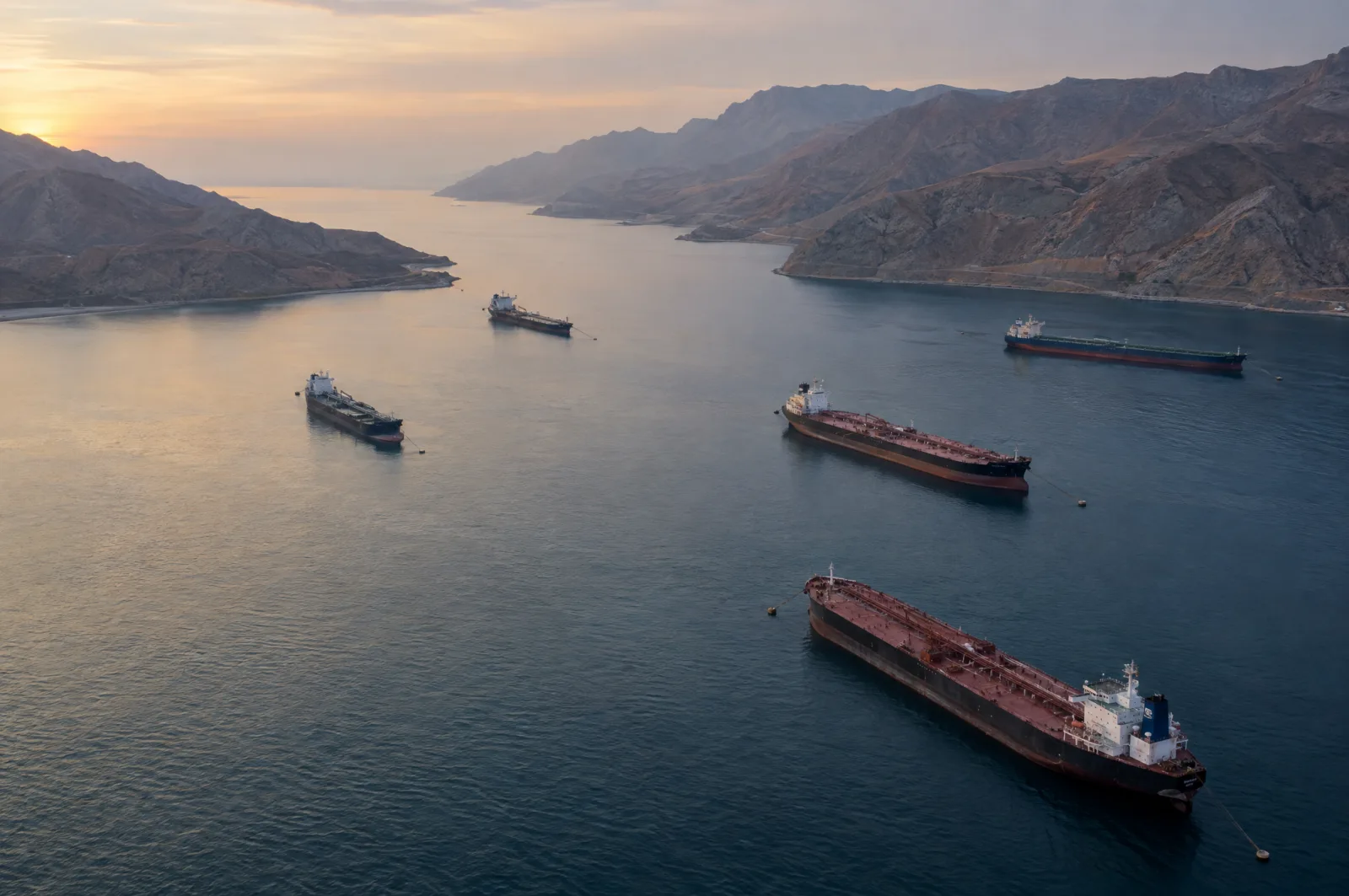
The Revolutionary Guard's account did not stop at two ships. Its navy said a third oil tanker also exploded after striking a naval mine in the Strait of Hormuz, in the same statement.
Neither report names the vessels, their flags or their operators, and neither says how many crew were aboard or whether anyone was hurt. The Guard said the two supertankers were abandoned after the explosions and were on fire.
Key numbers
- More than 4 million barrels of crude the Revolutionary Guard said the two supertankers were carrying
- 8.5 million barrels per day crude moving through Hormuz, according to data firm Kpler, about half the prewar level reached at the start of November
- One fifth of the world's oil and liquefied natural gas passed through the strait before the US-Israel assault on Iran began in late February
- More than a fifth the fall in benchmark Brent crude prices so far this month
What the Revolutionary Guard said
The IRGC Navy's public relations office said on Thursday that the two tankers attempted a covert passage along a restricted route despite warnings, and struck naval mines near the southern coast of the strait, islamicinvitationturkey.com reported.
The statement said the vessels were operating with support from US fighter jets, with surveillance drones overhead. It warned that tankers operating under the command of or in cooperation with the US military would be dealt with decisively if they used unauthorized routes.
The Guard, speaking to Iran's state broadcaster, said the ships were taking an "unauthorized route" through the conduit, Hellenic Shipping News reported.
What is confirmed and what is not
Very little, so far. The Associated Press said the Iranian claims could not be immediately verified, and US Central Command, which oversees US forces in the Middle East, did not comment, according to Hellenic Shipping News. There is no independent account of the explosions, the number of vessels involved or their cargo in either report.
Flows through the strait had already halved
Hormuz is the sea route out of the Persian Gulf, and it carried a fifth of the world's oil and LNG before the assault on Iran began in late February. Iran has moved to close it, though shipments improved in recent months, and Brent crude fell by more than a fifth so far this month.
Since the start of November, crude shipments through the strait appear to have fallen. Kpler put them at 8.5 million barrels per day, around half the prewar level reached at the beginning of the month.
Tanker crews have had to use ship-to-ship transfers to move barrels out of the Gulf, a risky procedure that has pushed vessel chartering rates higher, Hellenic Shipping News reported, citing media reports.
The standoff shows no sign of softening. The New York Times reported on Wednesday, citing US and Israeli officials briefed on the discussions, that President Donald Trump is weighing another round of extensive strikes on Iran and has not made a final decision. The same report said Prime Minister Benjamin Netanyahu is pushing Washington to join a four- to seven-day campaign of airstrikes.