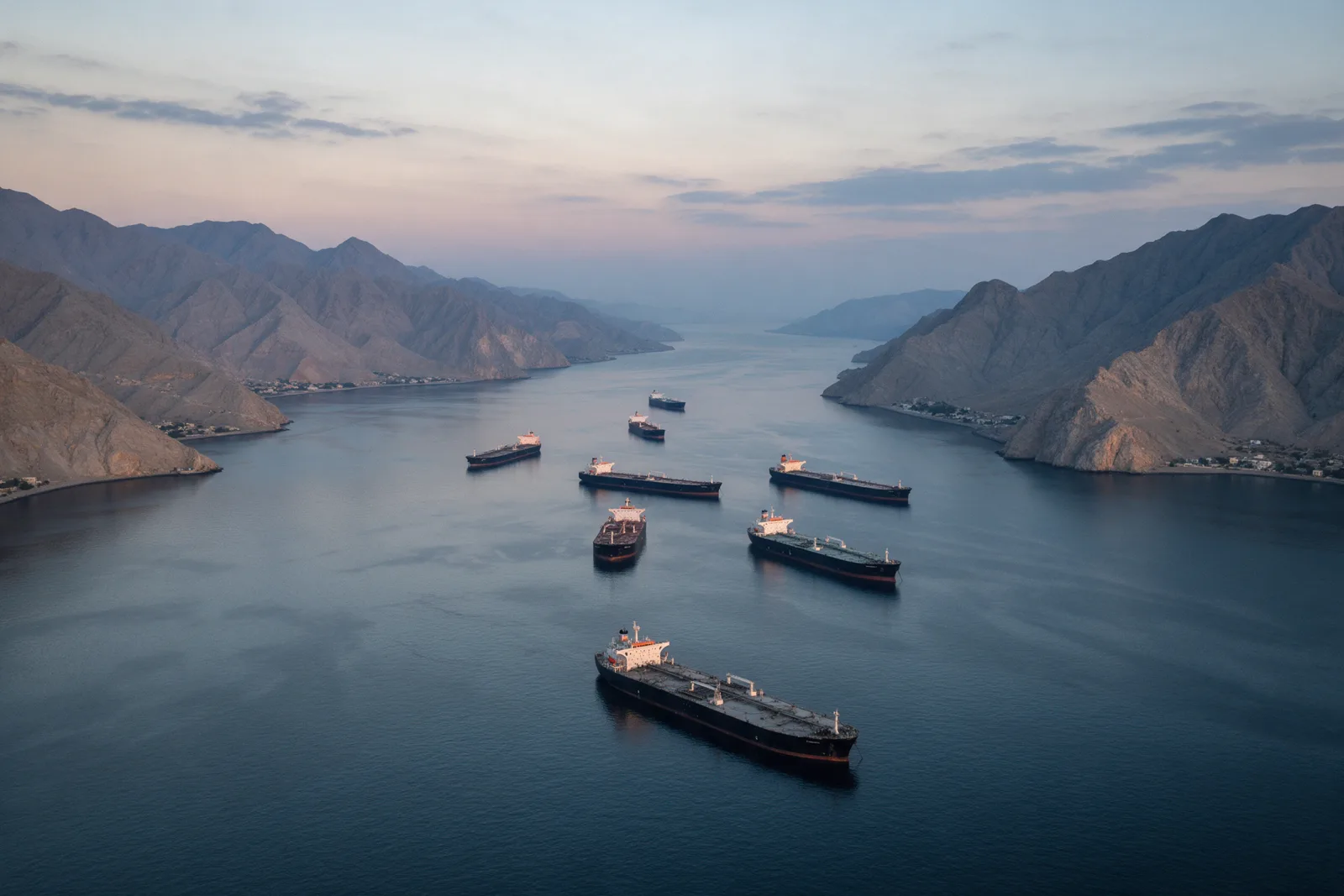
Less crude is actually passing through the Strait of Hormuz than before the war. Preliminary estimates for the week to October 18, which count cargo handed between ships in the Gulf of Oman, put traffic at roughly 14 million barrels a day, about 82% of the prewar rate, the Wall Street Journal reported.
The regional total is higher all the same, because a growing share of the oil never enters the strait. Pipelines running across Saudi Arabia and the United Arab Emirates move barrels to ports outside the Gulf, and tankers transfer cargo to one another beyond the chokepoint.
Key numbers
- More than 24 million barrels a day of Middle East oil flows in the week ending October 18, against a prewar average of 23.3 million, according to Kpler
- About 82% of prewar volume moving through Hormuz itself over the same week, on preliminary estimates
- 40% of the Gulf's non-Iranian crude exports in September took routes avoiding the strait, up from 17% before the war, Kpler estimated
- About 30 attacks on vessels reported in October, roughly 20% of all ship attacks logged during the war, according to Michelle Wiese Bockmann of maritime intelligence firm Windward
The workaround has become routine
The system that keeps the barrels moving was improvised and is now settled. Some tankers make brief runs into the Gulf, load, sail out through Hormuz and pass their cargo to a second ship near Oman, which carries it the rest of the way. Crews frequently cut their tracking signals for parts of the voyage, and American air cover shields a corridor along the Omani coast, though ships can still be hit.
Hamad Hussain, a senior commodities economist at Capital Economics, told the Times of India that the arrangement for shipping through a dangerous strait is well established by now, and that everyone in the export chain has grown more willing to accept the danger.
Money is a large part of why. Reselling Iraqi crude earns traders roughly $20 a barrel more than it did before the war, said Homayoun Falakshahi, who heads crude oil analysis at Kpler. On a supertanker loaded with a typical two million barrels, that is about $40 million of extra margin. Owners are paying up for people too: one China-based crewing agency offered seafarers as much as $25,000 for a round trip of one or two weeks, the Wall Street Journal reported.
In plain words: when a sea route turns dangerous, the oil does not simply stop. Insurance, freight and crew wages all get more expensive, and whoever can absorb those costs keeps sailing as long as the resale margin covers them. That is why a supply route can stay busy while the risk on it rises.
The cost of moving a barrel is the new problem
On October 16, a rocket-propelled grenade fired from a small boat struck the Tanzania-flagged supertanker Loyalty, the maritime security company Vanguard said. The grenade damaged a freshwater tank; a crew member said the ship was carrying two million barrels of Iraqi crude at the time. Neither report I read mentions any injuries. Iran's Islamic Revolutionary Guard Corps has used drones and missiles against ships making the crossing, and small boats have been used as well.
That danger shows up in the bills. Sending Gulf crude to China on a supertanker cost close to $37.37 a barrel this week, near a record, by Kpler's count, as Hindustan Times reported. War-risk insurance has climbed to as much as 10% of a vessel's value, from under 3% before the conflict, according to Windward. Brent crude traded around $108 a barrel on Tuesday, with global inventories thin and the recovery in flows dependent on how the fighting develops.
Iran's own exports are the ones squeezed
While its neighbors ship more, Iran ships less: a US maritime blockade has hemmed in its own oil trade. Tehran has argued that if it cannot export, nearby producers should not be able to either, and has pressed to reassert control over Hormuz. Crude keeps moving anyway, through the strait and around it, which Hussain said has cost Iran much of the deterrence it once held over regional exports.